

The songs of French diva Édith Piaf are an integral part of her country’s musical legacy. With melancholic melodies and lyrics, songs like “La Vie en Rose (Life in Pink),” “Non, je ne regrette rien (No, I Don’t Regret Anything),” and “La Foule (The Crowd)” strongly resonated with the working class of Paris and became cabaret and modern chanson icons. But one song, “La Foule,” began its musical journey two decades before Piaf’s 1957 recording.
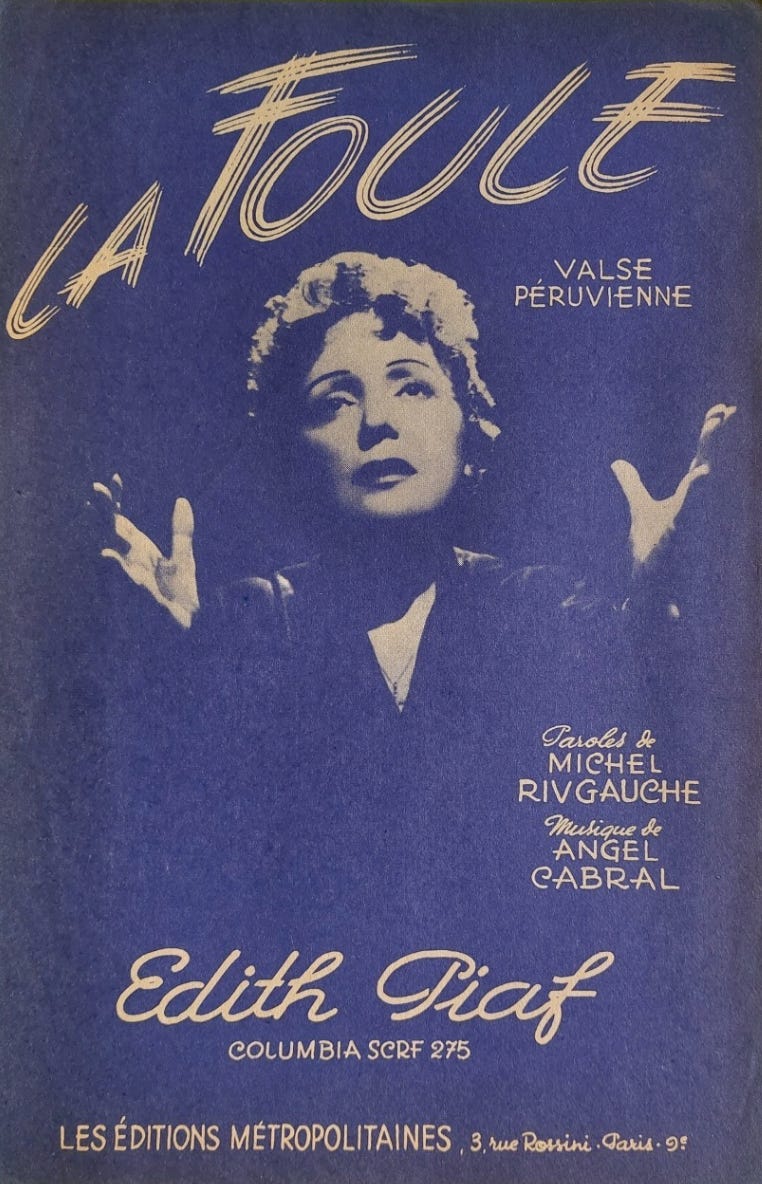
An antique musical score for “La Foule” has an image of Édith Piaf on the cover, and it gives attribution, in French, for the lyrics and music: paroles de Michel Rivgauche; musique de Ángel Cabral. It also has the annotation: Valse Péruvienne—Peruvian waltz. But how is “La Foule” connected to Peru’s creole waltz? The story begins in Argentina, not Peru.
In 1936, two Argentinian musicians released “Que nadie sepa mi sufrir (May No One Know My Suffering),” also known as “Amor de mis amores (Love of My Loves).” Ángel Cabral composed the music, and Enrique Dizeo wrote the lyrics. But, despite being Argentinian they didn’t produce a tango that honored their national dance, instead they intentionally chose the style of a vals criollo—the Peruvian creole waltz. Their song begins with the lament of a forlorn lover:
No te asombres si te digo lo que fuiste
Una ingrata con mi pobre corazón
Porque el fuego de tus lindos ojos negros
Alumbraron el camino de otro amor
Which translated to English is:
Don’t be surprised if I tell you what you were
An ingrate with my poor heart
Because the fire of your beautiful black eyes
Lit the path of another love
Recorded in the 1950s, one of the most popular versions of “Que nadie sepa mi sufrir” in Latin America is by the Ecuadorian singer Julio Jaramillo. The opening chords—syncopated staccato notes in 3/4 time signature—are instantly recognizable. First, there’s a piano and then a guitar begins marking the waltz rhythm. Although there is no percussion, the song carries the feeling of a Peruvian creole waltz.
So what is the feeling of the Peruvian creole waltz? While it does have a 3/4 time signature, the style is very different than the European waltz. In this video, I contrast both styles on my Afro-Peruvian cajón (box drum). The waltz from Europe is counted 1-2-3, and all beats have the same emphasis. But the Peruvian creole waltz is more like 1-2-and-3, which introduces a syncopation that invites dancers to move their hips and take short steps instead of gliding across the dance floor.
So how did “Que nadie sepa mi sufrir” become Édith Piaf’s “La Foule?” The story goes that Piaf was touring in Argentina when she heard the song. Liking the melody, she recorded her version, with lyrics by Michel Rivgauche that tell a tale of two lovers that are brought together then later separated by the movement of a crowd. You probably recognize the intro to “La Foule.” It starts with a piano, and then an accordion begins marking the waltz rhythm, followed by rousing horns.
In the decades that followed, more than two dozen international artists continued to transform “Que nadie sepa mi sufrir.” In 2007, Peruvian cumbia band Grupo 5 released “Amor de mis amores.” No longer a waltz, their interpretation has keyboards, conga drums, horns and the 4/4 time signature of the Caribbean rhythm from Colombia.
Then there’s the 2014 Flamenco rumba version by a former member of the Gypsy Kings. This version also has a 4/4 time signature, but the quick guitar strumming gives it a more upbeat vibe than the original, despite keeping the same melancholic lyrics.
There’s even a dance club oontz oontz version of “Que nadie sepa mi sufrir” with a heavy steady beat and electronic synthesizer that forgoes lyrics, making it more cheerful without the melancholic words of the original.
“Que nadie sepa mi sufrir” has journeyed around the world, from Argentina to France and beyond. But being a Peruvian creole waltz at heart, its sentimental home is no doubt Peru, so the song is very sentimental for Peruvian musicians. Peruvian tenor Juan Diego Flórez performed an operatic version in Paris, while Peruvian guitarist Jesus Gabriel plays an instrumental version that is very much in the style of Peru’s creole waltz of yesteryear.
But, regardless of who plays it or how it’s interpreted if it weren’t for the original Argentinian composers, we wouldn’t have this song today. So, whether you know it as “La Foule” or “Amor de mis amores” or “Que nadie sepa mi sufrir,” and whether you only listen to it or dance to it as well, you are being connected to Peru in a celebration of its emblematic creole waltz, its valse Péruvienne, its vals criollo.