

For more than a decade, Lima has been the world's top culinary destination. And dishes like ceviche, causa, palta rellena, antichuchos, and lomo saltado have shaped its comida criolla (creole cuisine). But in the city’s jerga criolla (creole slang), Peruvian food terms take on other meanings.
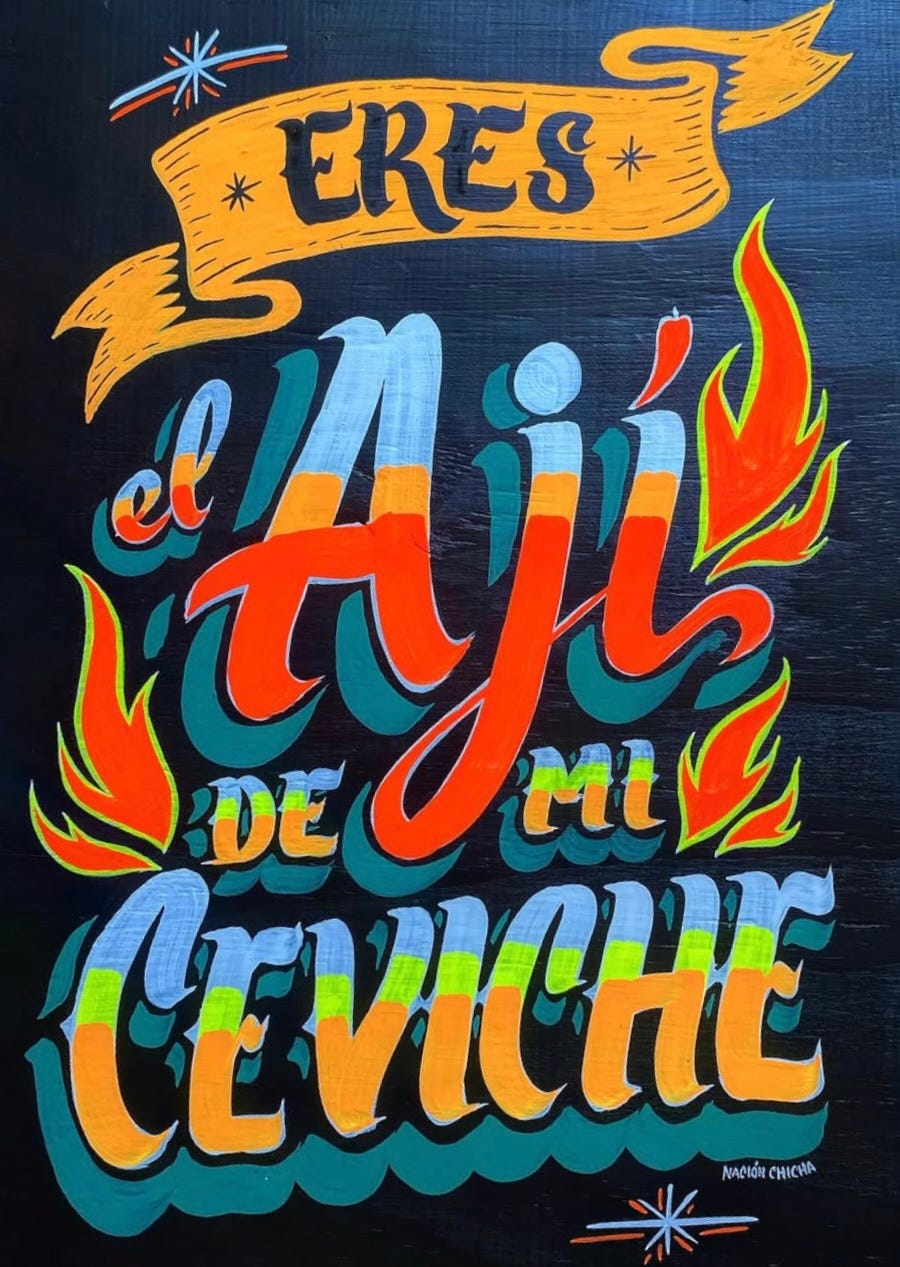
Recently, I came across a vibrant chicha style art by Nación Chicha that declares:
“Eres el ají de mi ceviche.”
Ají is hot pepper, the vital element in Lima’s creole dishes. And ceviche is Peru’s national dish of fish cured with lime juice, salt, ají, and onions. A direct translation is “You are the hot pepper in my ceviche,” but the true meaning is more like:
“You are the spice in my life.”
Beyond this colorful and romantic example, food terms appear in other popular phrases. Listen carefully as you walk down the bustling streets of Lima. There is the commanding pierce of a traffic cop’s whistle, cars honking their way through busy intersections, the aging roar of diesel-engine buses, street vendors shouting about their offerings, and creole songs pouring out of bars. But cutting through those urban sounds are limeños (people from Lima) conversing with colloquial phrases:
“¿Oye causa, cuál es tu cau cau?”
“¡Llegué tarde a la chamba, qué piña!”
“Dame un huachito que me siento lechero.”
“Para llegar a la playa anda de fresas por esa calle.”
“¡Por gusto me preocupé, fué papayita!”
“Pídele su número, no seas palta.”
“Tiene plata como cancha.”
“Ya deja de estar enojado y pela los choclos.”
“¡Chaufa, nos vemos el fin de semana!”
Even if you are fluent in Spanish, did you catch all of that? Perhaps you recognized some traditional creole dishes, such as causa, or fruits and vegetables like piña (pineapple), fresas (strawberries), or palta (avocado). But what do these phrases mean? Let’s dissect them one by one:
“¿Oye causa, cuál es tu cau cau?” — Causa, the chilled potato mash with savory toppings, is a close friend. While cau cau, the tripe and potato stew with yellow hot peppers, is a problem. Combined, you get, “Hey buddy, what’s your problem?”
“¡Llegué tarde a la chamba, qué piña!” — Chamba, derived from chamber of commerce, means your job, and piña is to have bad luck. So “I arrived late to work, how unlucky!” is a way to explain your tardiness.
“Dame un huachito que me siento lechero.” — Huachito is a partial lottery ticket, and lechero is someone who has good fortune. So a person who is lechero could say, “Give me a lotto, I am feeling lucky.”
“Para llegar a la playa anda de fresas por esa calle.” — Fresas are strawberries, but it is a play on de frente (straight ahead). Directions to the playa (beach) then become, “To get to the beach go straight ahead on that street.”
“¡Por gusto me preocupé, fué papayita!” — Papaya means something that was easy (papayita is the fruit’s diminutive), and preocupar is to worry. So if something isn’t as hard as expected, you’d say, “I worried for nothing, it was easy!”
“Pídele su número, no seas palta.” — Palta is what Peruvians call an avocado and it stands for being shy or embarrassed. So a friend’s encouragement to get someone’s contact information becomes, “Ask for their number, don’t be shy.”
“Tiene plata como cancha.” — Cancha is the snack of Andean toasted corn kernels that overflow from a bowl at a bar. It’s synonymous for a large amount of something like plata (money). So the phrase means, “They have lots of money.”
“Ya deja de estar enojado y pela los choclos.” — Choclo is Quechua for corn. So, pela los choclos (peel corn husks) is to show your teeth (that resemble corn kernels) and smile. You’d say, “Stop being upset and smile,” to someone enojado (angry).
“¡Chaufa, nos vemos el fin de semana!” — In Lima we say chau for goodbye. Here, chaufa, the Chifa (Chinese-Peruvian) fried-rice dish, is a play on chau. Fin de semana is weekend, so a farewell could be, ”Goodbye, see you next weekend!”
That the language of food spills over into daily life is one of the elements of criollismo. This slang speak is a form of hip code-switching that limeños use to show that they have calle (street smarts), and transforms quotidian phrases into something playful.
Listen for these jerga criolla phrases when you travel to Lima. Their meaning goes beyond the food you’ll be eating there, and if you practice a little bit, you’ll be sounding like a limeño in no time. Until my next newsletter, chaufa!
Such inventive and creative slang, Nico! Thanks for sharing! ❤️
My husband from Lima always calls me causa… now I know I am literally mashed potato!