

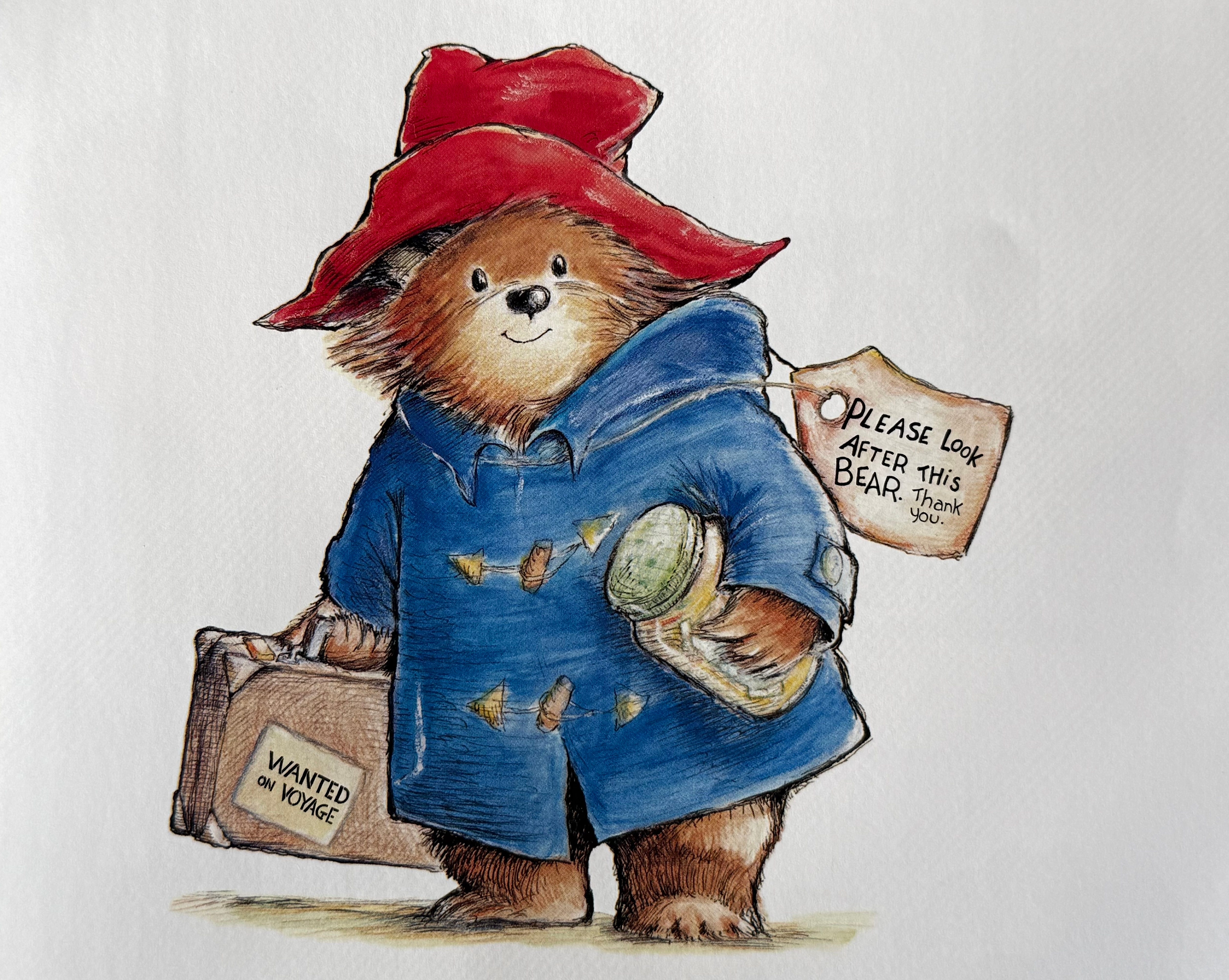
When I became a dad, The Paddington Treasury was one of the first books I placed on my child’s bookshelf. Of course we had other classics like Winnie the Pooh, The Cat in the Hat, and The Little Prince. But Paddington came from Peru, and being proud of my ancestry I wanted to instill a connection to Peru during story time.
On the surface, the misadventures of the anthropomorphic Peruvian bear are charming. The comical castaway that carries a jar of orange marmalade in case of emergencies ends up in London and troubles ensue. But as I dove into the character’s origin and stories, I began to uncover a problematic colonial narrative.
“Darkest Peru”
In Michael Bond’s 1958 debut book, A Bear Called Paddington, Mr. and Mrs. Brown ask the bear where he is from. Paddington replies, “Darkest Peru.” The author wanted his character to be from somewhere exotic. Originally, Paddington was to be from Africa, but because there are no bears there Africa became Peru.
However, the term “Darkest Peru” perpetuates the colonial notion that Western culture is civilized and others places (be it Peru or Africa) are dark or exotic and dangerous. As a result, these places are waiting to be discovered by white men who exploit cultures and write history from a Western perspective.
Now, Paddington does resemble the Andean spectacled bear, the only species native to South America that inhabits the mountains of Peru and neighboring countries. But to make him more civilized, the author has him sporting a British style coat and hat. And nothing about how Paddington is presented points to his true origin.
Immigrant Stories
Paddington’s story is that of an immigrant that has assimilated into British society. He lives with a middle-class family, speaks English, not Spanish or Quechua, is polite and tries not to stand out. That is, he has surrendered, or been pressured to surrender, his Peruvian identity. But what makes one Peruvian?
Do you need to speak Spanish or Quechua? Do you need to cook or eat traditional Peruvian food? Do you need to listen to Peruvian music? Do you need to read Peruvian literature? Do you need to live in Peru? Of course anyone can do all of those things, so what then defines identity?
As an immigrant myself, I believe that cultural identity is complex and can change over time. No matter where I’ve resided, and I’ve lived outside of Peru for more than half-century, Peru has always felt like home. Nothing compares to the feeling of being in the Andes mountains, or recalling the memories of my time there with family.
So, I’ve strived to preserve all the things that make me feel Peruvian. And I’m grateful that I’ve lived in places where that was possible. Unfortunately, even though he’s just a character in a story, it matters that Paddington was not afforded that same opportunity. The message, to children everywhere, is to fit in. But at what cost?
Postcolonial Whitewashing
In the tradition of Western explorers who reframe stealing land as a “discovery,” the Brown family discovered the bear at Paddington train station in London. And so they decided to call him Paddington. However, the bear’s original name was Pastuso, but using the excuse it was difficult to pronounce, they erased it.
This postcolonial whitewashing reminded me of recipe names, specifically for Peruvian dishes. I will always call causa by its original name, not something like “chilled potato salad.” Causa may not mean anything to a Western ear, but the name is Quechua for “sustenance,” so it’s imbued with cultural significance.
I don’t think anyone has asked a chef from Spain to rename gazpacho to “chilled tomato soup” so readers could understand what the dish is. Likewise with paella, the names carries a cultural identity and everyone had to learn its meaning. It should be the same for Peruvian dishes, and for Paddington’s name.
Lack of Accountability
Recently, my children asked to watch the Disney film The Jungle Book. They already knew most of the songs and had seen clips of the characters joyfully singing and dancing. But at the start of the film, there was a message I had not seen before:
“This program is presented as originally created. It may contain outdated cultural depictions.”
Disney finally admitting that their film has racial and cultural biases. Today, I am hoping we know better. But even the original story by Rudyard Kipling is written from a colonial perspective depicting a metaphorical caste system in the jungle.
I wish that the Paddington Bear books had a similar message. Some words to show accountability for the author’s “outdated cultural depictions.” But until that happens, it’s up to me as a father to come up with a solution.
Intergenerational Storytelling
Instead of banning Paddington Bear, I will continue to read the books to my children at story time. But as they get older I will encourage a dialogue about the character and what he represents. By being curious, and asking questions instead of simply condemning a book, we can explore ways to learn something from the stories.
My Quechua ancestors were storytellers. And as part of the Andean Cosmovision they sometimes told stories to heal and correct the past. I think in some ways we can do the same with Paddington Bear. One question could be, “Instead of saying the bear is from Darkest Peru, what can we say that decolonizes his origin?”
I am certain that the answer my children give will surprise me, as it will be something that never occurred to me. Perhaps the Paddington books, though flawed, are meant to give us an opportunity to participate in intergenerational storytelling. For only by reflecting on socio-colonial issues around the world can we strive to make it better.