

I remember Dad’s LP vinyl collection—a catalogue of traditional Peruvian music from the 70s and 80s. Growing up, we listened to upbeat Afro-Peruvian rhythms, the melancholic creole waltz, and soulful songs from the Andes. At reunions with friends and family, Dad walked around the living room pouring pisco sours for the guests while the melody of “El Cóndor Pasa” played in the background.
A friend once commented that “El Cóndor Pasa” sounded like the 70s song “If I Could” by Simon & Garfunkel. Because “El Cóndor Pasa” was written in 1913 by Peru’s Daniel Alomía Robles, this was cultural theft. Consequently, the Peruvian composer’s family successfully sued the American musicians for copyright infringement. To this day, I am not a fan of Simon & Garfunkel.
Dad’s LPs defined my musical world at home. And just like Mom’s cooking, music was an integral part of our Peruvian identity. Back then, Peruvian music was not well known outside of Peru. But in 1995, everything changed with the release of The Soul of Black Peru, a compilation of Afro-Peruvian songs produced by David Byrne’s label Luaka Bop. This I was a fan of, and I played my CD on repeat.
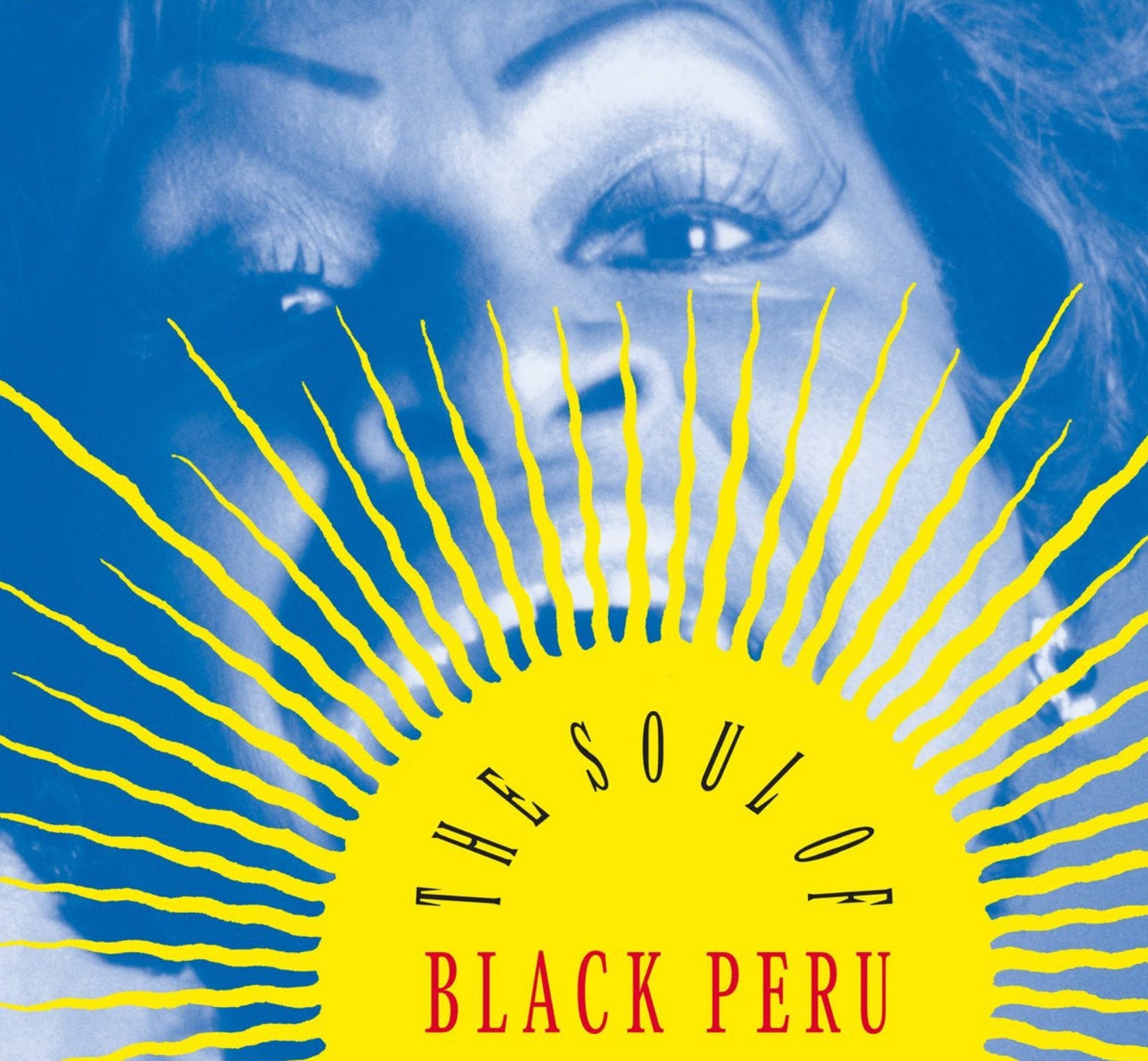
Byrne, the lead singer of The Talking Heads, is the antithesis of Simon & Garfunkel when it comes to global music. Instead of stealing, Byrne celebrates, promotes, and shares the musical cultures of Peru, Brazil, Cuba, Asia, and Africa with the world. One song from The Soul of Black Peru stood out, “María Landó” by Susana Baca. Because of this exposure, she quickly gained international acclaim.
Eventually, Susana Baca toured around the world and won three Latin Grammy Awards. One time, I took my mom to see Susana Baca in concert, and the next day she cooked with my mom at a friend’s house while her band played for us. In her music, the cajón box drum marks the rhythms of Black Peru while the arrangements on guitar and bass introduce more modern jazz elements.
As a child, our parents took us to see Perú Negro at a local theatre. I was captivated by the Afro-Peruvian drumming and dancing of the national troupe. Susana Baca pays homage to many of the songs and traditions that Perú Negro rescued, largely due to the work of activist, singer, and choreographer Victoria Santa Cruz. Then, in the early 2000s, I heard the next evolution of Peruvian music: Novalima.
Founded by a group of musicians and DJs, Novalima fuses Afro-Peruvian rhythms with electronica. The voice and cajón are there, but so are the hard-driving electric guitar and bass, drum kit, timbales, synthesizer, plus DJ. To purists, this was an affront. But I’ve seen Novalima perform twice and truly appreciate how they promote Peru’s culture across a world that thrives on live concerts and dance club vibes.
“Camote” is a traditional Afro-Peruvian song by Caitro Soto and Rafael Santa Cruz. But in their version, Novalima adds a rocksteady beat and ska trumpet to make it a catchy and danceable tune that’s now popular in Peru and beyond. I think that this fusion not only works, but their music and lyrics educate the world about Peru’s Black history of resistance and resilience.
One of Peru’s greatest singers was Chabuca Granda, and many of her songs bring to life the Lima of yesteryear. “La Flor de la Canela” is one such song, a creole waltz with guitar and voice that begins:
Déjame que te cuente, limeño
Déjame que te diga la gloria
Del ensueño que evoca la memoria
Del viejo puente, del río y la alameda
Which translates to:
Let me tell you, Limeño (man from Lima)
Let me tell you about the glory
Of the daydream that evokes the memory
Of the old bridge, the river, and the promenade
For most of my life, when I recalled the song, I only heard the haunting voice of Chabuca Granda. But the contemporary Peruvian tenor Juan Diego Flórez altered that. The posthumous duet with Chabuca Granda brings together a Peruvian classic and the world of opera. So this is yet another fusion of musical styles that is still deeply Peruvian in soul with voices that powerfully proclaim Lima’s memories.
As much as Peru’s creole and Afro-Peruvian music have evolved, I always thought Andean music would stay the same, with musicians singing in Quechua and playing the pan flute, charango guitar, or bass drum. My mom loved listening and dancing to old Huayno songs from her Andean home. But after I heard Renata Flores, I realized Andean music had entered a new era.
The young diva is preserving the language of her ancestors by singing pop songs in Quechua. Her interpretation of Michael Jackson’s “The Way You Make Me Feel” is one way to inspire Peru’s Andean youth—who are already captivated by pop music—to learn about their roots and their language. Renata Flores is also a powerful voice for feminism, and I think my mom would’ve liked her music and mission.
Years ago, on a trip to Lima with my mom and dad, I saw the documentary Sigo Siendo (Still Being), a musical journey across Peru from the Amazon, to the Andes Mountains, to coastal Afro-Peruvian communities. It reminded me that Peru’s music is as diverse as its geography, culture, and its people. In Sigo Siendo (Still Being) musicians across Peru share their connections to music and life:
“I don’t think anyone can live without music, can you live without music?”
”That is life, dancing, adding more life to life, that is life.”
”Each musical vibration gives me life.”
After more than half a century of listening to Peruvian music, I can say this: just like we grow, change, and evolve, music does too. So let’s sing pop in Quechua, listen to an operatic creole waltz, or dance to an Afro-Peruvian song with electronica beats. By doing so we may be changing musical traditions but also keeping them alive, honoring them, and making Peruvian music accessible across generations.